
# This is a basic VCL configuration file for varnish.  See the vcl(7)
# man page for details on VCL syntax and semantics.
#
# Default backend definition.  Set this to point to your content
# server.
#

probe healthcheck {
   .url = "/";
   .interval = 60s;
   .timeout = 0.3s;
   .window = 8;
   .threshold = 3;
   .initial = 3;
}

#backend local {
#	.host = "127.0.0.1";
#	.port = "80";
#}

backend web244 {
	.host = "192.168.2.244";
	.port = "80";
	.probe = healthcheck;
}
backend web243 {
	.host = "192.168.2.243";
	.port = "80";
	.probe = healthcheck;
}
backend web232 {
	.host = "192.168.2.232";
	.port = "80";
	.probe = healthcheck;
}

director default round-robin {
	{ .backend = web244; }
	{ .backend = web243; }
}

director image fallback{
	{ .backend = web232; }
	{ .backend = web243; }
}

#
# Below is a commented-out copy of the default VCL logic.  If you
# redefine any of these subroutines, the built-in logic will be
# appended to your code.
sub vcl_recv {
#     if (req.restarts == 0) {}

	if (req.http.x-forwarded-for) {
 	    set req.http.X-Forwarded-For =
 		req.http.X-Forwarded-For + ", " + client.ip;
 	} else {
 	    set req.http.X-Forwarded-For = client.ip;
 	}

	if (req.http.host == "static.aooshi.org"
	|| req.http.host == "image.aooshi.org"
	) {
		set req.backend = image;
	}

#     if (req.request != "GET" &&
#       req.request != "HEAD" &&
#       req.request != "PUT" &&
#       req.request != "POST" &&
#       req.request != "TRACE" &&
#       req.request != "OPTIONS" &&
#       req.request != "DELETE") {
#         /* Non-RFC2616 or CONNECT which is weird. */
#         return (pipe);
#     }

     if (req.request != "GET" && req.request != "HEAD") {
         /* We only deal with GET and HEAD by default */
         return (pass);
     }

#     if (req.http.Authorization || req.http.Cookie) {
     if (req.http.Authorization) {
#         /* Not cacheable by default */
         return (pass);
     }
     return (lookup);
}
#
# sub vcl_pipe {
#     # Note that only the first request to the backend will have
#     # X-Forwarded-For set.  If you use X-Forwarded-For and want to
#     # have it set for all requests, make sure to have:
#     # set bereq.http.connection = "close";
#     # here.  It is not set by default as it might break some broken web
#     # applications, like IIS with NTLM authentication.
#     return (pipe);
# }
#
# sub vcl_pass {
#     return (pass);
# }
#
# sub vcl_hash {
#     hash_data(req.url);
#     if (req.http.host) {
#         hash_data(req.http.host);
#     } else {
#         hash_data(server.ip);
#     }
#     return (hash);
# }
#
sub vcl_hit {
     return (deliver);
}
#
# sub vcl_miss {
#     return (fetch);
# }
#
sub vcl_fetch {
     if (beresp.ttl <= 0s ||
         beresp.http.Set-Cookie ||
         beresp.http.Vary == "*" ||
         beresp.http.Pragma == "no-cache" ||
         beresp.http.Cache-Control == "no-cache" ||
         beresp.http.Cache-Control == "private" ||
         beresp.status != 200
        ) {
#               /*
#                * Mark as "Hit-For-Pass" for the next 2 minutes
#                */
#               set beresp.ttl = 120 s;
                return (hit_for_pass);
     }
     return (deliver);
}
#
sub vcl_deliver {
	remove resp.http.X-Varnish;
#	remove resp.http.Via;
     if (obj.hits > 0) {
        set resp.http.X-Cache = "HIT from " + server.hostname;
     }
	return (deliver);
}
#
# sub vcl_error {
#     set obj.http.Content-Type = "text/html; charset=utf-8";
#     set obj.http.Retry-After = "5";
#     synthetic {"
# <?xml version="1.0" encoding="utf-8"?>
# <!DOCTYPE html PUBLIC "-//W3C//DTD XHTML 1.0 Strict//EN"
#  "http://www.w3.org/TR/xhtml1/DTD/xhtml1-strict.dtd">
# <html>
#   <head>
#     <title>"} + obj.status + " " + obj.response + {"</title>
#   </head>
#   <body>
#     <h1>Error "} + obj.status + " " + obj.response + {"</h1>
#     <p>"} + obj.response + {"</p>
#     <h3>Guru Meditation:</h3>
#     <p>XID: "} + req.xid + {"</p>
#     <hr>
#     <p>Varnish cache server</p>
#   </body>
# </html>
# "};
#     return (deliver);
# }
#
# sub vcl_init {
# 	return (ok);
# }
#
# sub vcl_fini {
# 	return (ok);
# }
其它:
(1) Receive状态,也就是请求处理的入口状态,根据VCL规则判断该请求应该是Pass或Pipe,或者进入Lookup(本地查询)。
(2) Lookup状态,进入此状态后,会在hash表中查找数据,若找到,则进入Hit状态,否则进入miss状态。
(3) Pass状态,在此状态下,会进入后端请求,即进入fetch状态。
(4) Fetch状态,在Fetch状态下,对请求进行后端的获取,发送请求,获得数据,并进行本地的存储。
(5) Deliver状态, 将获取到的数据发送给客户端,然后完成本次请求。
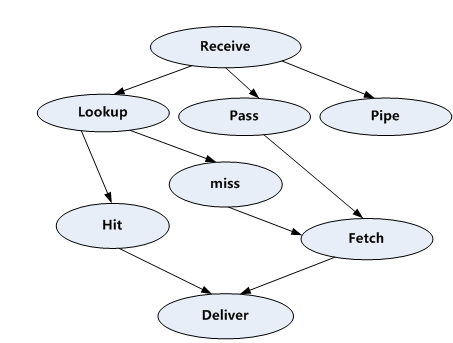
实例解析:
#
# This is an example VCL file for Varnish.
#
# It does not do anything by default, delegating control to the
# builtin VCL. The builtin VCL is called when there is no explicit
# return statement.
#
# See the VCL chapters in the Users Guide at https://www.varnish-cache.org/docs/
# and http://varnish-cache.org/trac/wiki/VCLExamples for more examples.
# Marker to tell the VCL compiler that this VCL has been adapted to the
# new 4.0 format.
vcl 4.0;
import directors;
probe backend_healthcheck { # 创建健康监测
.url = /health.html;
.window = 5;
.threshold = 2;
.interval = 3s;
}
backend web1 { # 创建后端主机
.host = "static1.lnmmp.com";
.port = "80";
.probe = backend_healthcheck;
}
backend web2 {
.host = "static2.lnmmp.com";
.port = "80";
.probe = backend_healthcheck;
}
backend img1 {
.host = "img1.lnmmp.com";
.port = "80";
.probe = backend_healthcheck;
}
backend img2 {
.host = "img2.lnmmp.com";
.port = "80";
.probe = backend_healthcheck;
}
vcl_init { # 创建后端主机组,即directors
new web_cluster = directors.random();
web_cluster.add_backend(web1);
web_cluster.add_backend(web2);
new img_cluster = directors.random();
img_cluster.add_backend(img1);
img_cluster.add_backend(img2);
}
acl purgers { # 定义可访问来源IP
"127.0.0.1";
"192.168.0.0"/24;
}
sub vcl_recv {
if (req.request == "GET" && req.http.cookie) { # 带cookie首部的GET请求也缓存
return(hash);
}
if (req.url ~ "test.html") { # test.html文件禁止缓存
return(pass);
}
if (req.request == "PURGE") { # PURGE请求的处理
if (!client.ip ~ purgers) {
return(synth(405,"Method not allowed"));
}
return(hash);
}
if (req.http.X-Forward-For) { # 为发往后端主机的请求添加X-Forward-For首部
set req.http.X-Forward-For = req.http.X-Forward-For + "," + client.ip;
} else {
set req.http.X-Forward-For = client.ip;
}
if (req.http.host ~ "(?i)^(www.)?lnmmp.com$") { # 根据不同的访问域名,分发至不同的后端主机组
set req.http.host = "www.lnmmp.com";
set req.backend_hint = web_cluster.backend();
} elsif (req.http.host ~ "(?i)^images.lnmmp.com$") {
set req.backend_hint = img_cluster.backend();
}
return(hash);
}
sub vcl_hit { # PURGE请求的处理
if (req.request == "PURGE") {
purge;
return(synth(200,"Purged"));
}
}
sub vcl_miss { # PURGE请求的处理
if (req.request == "PURGE") {
purge;
return(synth(404,"Not in cache"));
}
}
sub vcl_pass { # PURGE请求的处理
if (req.request == "PURGE") {
return(synth(502,"PURGE on a passed object"));
}
}
sub vcl_backend_response { # 自定义缓存文件的缓存时长,即TTL值
if (req.url ~ "\.(jpg|jpeg|gif|png)$") {
set beresp.ttl = 7200s;
}
if (req.url ~ "\.(html|css|js)$") {
set beresp.ttl = 1200s;
}
if (beresp.http.Set-Cookie) { # 定义带Set-Cookie首部的后端响应不缓存,直接返回给客户端
return(deliver);
}
}
sub vcl_deliver {
if (obj.hits > 0) { # 为响应添加X-Cache首部,显示缓存是否命中
set resp.http.X-Cache = "HIT from " + server.ip;
} else {
set resp.http.X-Cache = "MISS";
}
}